Saturday, February 28, 2015

Sunset on the Wild Atlantic way

Last summer - 2014 - I had the opportunity to drive from Cork to Donegal when the weather was good, warm sunny days with pleasant breezes. A lot of my journey took me along the Wwild Atlantic Way and it was fantastic to have the opporunity to see the beauty of the Irish countryside and the breathtaking scenery in so many parts of Ireland's western coastline. While I have been aware of the beauty of Ireland's landscape for many years and have found it a great source of inspiration for my paintings I had never appreciated how many places had such rugged beauty. It was a real awakening for me to see the amazing light on the fields and hills in every county along Ireland's coastline. I was enchanted by the force and strength of the rocks and cliffs along the Atlantic coastline. The mesmerising sound of the waves crashing against the cliff faces or lapping the sand on so many beautiful hidden beaches in Cork, Kerry, Clare and further up along the coast. I was on hoidays and travelled at my leisure along my route stopping in many small villages to savout the slow steady pace of life.
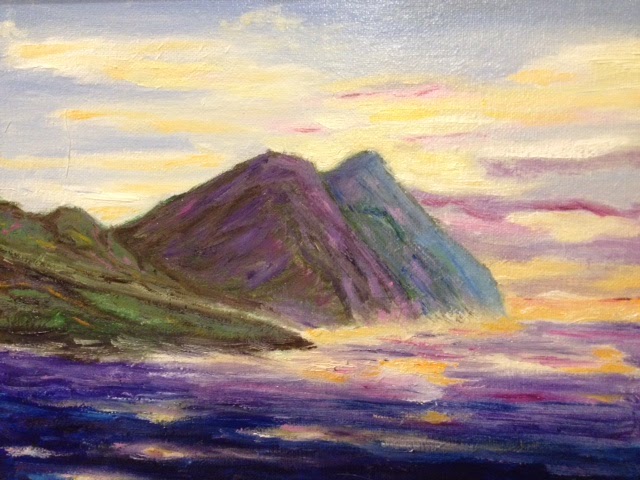
Many times on my way I stopped to just look and soak up the beauty of a shaft of sunlight on a green field or the ripple of the wind through a field of golden corn ripening in the late summer sunshine. Many evenings as I paused in unflagged beauty spots to watch the setting sun I was amazed the beauty of the light on the shimmering sea water and the soft light on the rolling hills, rugged mountains and craggy cliffs that give Ireland such a magically natural beauty. I have painted a scene to capture this wild beauty.


 In the summertime heather grows profusely and there is an amazing clarity and softness to the lilacs,purples and whites that cover hills and mountains along the west coast. In many places you will see where turf has been cut and the rich dark browns of the peat create the perfect contrast for the soft purples. Irish hills are covereud by a sctutch grass that has an intriguing greenish yellow hue. This grass can grow up to 1 foot in length and as it dries in the strong winds and soft breezes of the west coast it beomes a soft brown or golden colour, especially in the yellow and orange light of the setting sun. I have included all these colours in the small painting of the Wild Atlantic Way. The painting measures 12 x 10 inches (30 x 25 cm) but I am very pleased with how I have captured the light and the beautiful colours of the Irish coastline in the setting sun. The sea reflects the purple hue of the heather covered hills which richly contrasts with the rich yellow/orange tones of the setting sun. There is deep blue colour in the sea water in the foreground of the painting to give a sense of its depth and hidden power. The hills in the left foreground have the rich browns and dark greens of peatlands near the coast. Even though the sun is setting there is still a soft blue to the sky to show the softness of light at this northerly latitude and that while the sun is setting it brings a slow and beautiful transformation to the Irish coastline. It is a scene that people would identify with many parts of Ireland's beautiful western coastline. I look forward to further travels on the Wild Atlantic way in many summers to come.

Saturday, February 21, 2015

Back to my youth growing up on a farm in Kerry

Recently I was at an art auction and I saw a painting of some cows that really appealed to me.It was very atmospheric and captured the sense of animals together in a very natural way. It immediately reminded me of the cows and calves on the farm at home in Kerry. There were particular cows that had great personality and you had a sense of how protective they were of their young calves. I decided that I would do a painting that would capture that sense of cows nurturing calves. I wanted to show the solidity of the cow looking out over the landscape and how calm and at ease she was in her natural environment. Beside her I have put her young calf. I have painted him by his mother's side so that I convey the sense of security that the young calf feels beside his mother.
                                                             
The cow is looking straight ahead while the calf is looking out to the side. I wanted to give a sense of confidence and ease in the cow's demeanour while showing a nervousness in the calf. He is young and unsure of himself in this strange new world. The cow is an off-white -Charolais-.with tinges of brown while the calf is strongly brown - Limousin breed- to create an attractive contrast in their colours. The scene is set on a sunny summer's evening with a lovely soft light falling on the animals which gives a great opportunity to show rich areas of light and shadow.
My father was a dairy farmer and he built a fine herd of Friesian cows to supply milk to Kerry Co-Op. He was always interested in breeding animals and from to time experimented with beef cattle and also had sheep to see how they would contribute to the farm income. At one stage an uncle of mine persuaded him to get some Charolais cows and to cross breed them with a Limousin bull. The result is what you see depicted in the painting. My father's main interest and income was from dairy cows so while he was interested enough to try out other cattle on my uncle's prompting he did not persist with the Charolais and Limousin breeds. As children we were greatly taken with these big colourful animals. They were a welcome change from the constant black and white of the Friesian cows.

The farm  near Listowel is not beside the sea but I took the artistic licence to put the sea as a background beacuse the cloours of the sky and the water would set off the animals very well.  

Monday, April 21, 2014

Iconic Inis Tuaisceart


The view of Inis Tuaisceart is engrained on my mind for a number of reasons. Firstly as a young secondary school student I saw it every year that I visited the west Kerry Gaeltacht. It was part of the 3 week course that we would go on a cycling trip of the local area and the circuit around Slea Head was always greatly looked forward to and enjoyed by students and teachers. We would pass this view on our way from Baile an Fheirteirigh to Dun Chaoin and it always struck me as an amazing place, 3 miles out from the mainland across a treacherous stretch of water. It sits beside the Great Blasket Island but was not inhabited on a year round basis like the bigger island. Apparently the Blasket Islanders would put sheep to graze on it for the summer months and young men would be sent to Inis Tuaisceart to look after the sheep. We saw it in all kinds of weather, from bright sunshine to pouring rain and sometimes we could barely make out the outline of the island through the mist and fog. I remember also that RTE used it as their last image as they played the national anthem and shut down broadcasting each night in the 1970's and 80's. They had a beautiful image as the sun was setting over the island on a late summer's evening. There was a golden glow to that image and it made Inis Tuaisceart seem like an idyllic place. There was a sense of peace and contentment to it. When I studied the literature of the Blasket Islands I was amazed by the quality of the writing and the stories of the lives of the people who lived in these remote parts scratching out a living from the land and the sea. The harshness of the landscape gave Peig Sayers, Tomás O Criomhthainn and other island writers, an ability to see the richness of the life around them and to capture the character of the people in their struggles and toils. The perpetual struggle with the unyielding elements and landscape proved too much for many of the islanders so that they emigrated to America and other far flung parts to try and build a better life for themselves. The Great Blasket island was evacuated in 1953 and has largely remained uninhabited since that time. The story of their lives is told in the Blasket Centre in Dun Chaoin. The setting of the centre is ideal for getting a sense of the people and the landscape as when you walk down to the end of the display area, which has all the information on the lives of the people, you can look directly out on the islands. In my painting of Inis Tuaisceart I wanted to capture a sense of the powerful and treacherous sea that the islanders had to row across in all kinds of weather to fetch priests and doctors to tend to their physical and spiritual needs. Inis Tuaisceart is also known as 'The Sleeping Giant and as 'An Fear Marbh' (The Dead Man) because the outline of the island look like a body in repose, sleeping soundly and calmly, and also ready to be taken away for burial. I wanted to show serenity and calmness in the landscape and also to convey the solidity of a seaswept island that has endured the ravages and battering of the Atlantic waves for thousands of years. The land on the island is poor quality and gives little possibility of growing crops to sustain any brave folk who might seek to eke out a living there. As a result of this you can see in the painting that there are no houses or signs of habitation. I wanted to give a sense that Inis Tuaisceart is almost aloof and removed from the cares of our world. There is a softness to the empty landscape but also a sense of a faded of jaded life.

Sunday, September 1, 2013

Celebrating the life and lamenting the passing of Seamus Heaney

The sunshine in Cork cannot dispel the sadness we feel at the passing of one of the ‘greats’ in Irish life. One of our national treasures, Seamus Heaney, died yesterday,
 30 August ’13. A man whom I greatly admired and respected. A wonderful scholar and learned man imbued with the culture and history of his native land. He has left us a rich legacy of poetry and writings on so many aspects of life, culture, history, tradition, relationships, connections and much much more.
He celebrated his 70th birthday in 2009 and I remember reading how he cherished his farming background and upbringing in Co.Derry. This struck a chord with me as I am also a son of the land, reared on a farm 3 miles west of Listowel, Co.Kerry. I have always loved the rural life and have been fascinated by the contours, textures, colours of the Irish landscape as it changes through the seasons.
In tribute to Seamus I did a small painting to celebrate his 7 decades in 2009. It is a scene from rural Co.Derry which I hoped would evoke memories of his beloved home and farm at Mossbawn. It was an autumnal scene to convey the richness of the landscape, fertility of the soil and the rich harvest of his own work. In the left middle ground there is an oak tree to connect him to the heritage of his native Derry – the oak leaf county. The oak is a symbol of kingship which I felt was appropriate for Seamus – a prince of learning and writing.
I placed the tree in a background of sloping hills and fields as I felt this landscape would reflect the contours and changes in life. It represents a lifetime of work and changes and a fruitful harvest after seasons of toil and labour.
I painted the scene with a golden autumn light filtering across the fields which mingles with the golden stubble of the recently harvested corn. The light also catches the yellows and golds of the autumn leaves and acorns on the oak tree. To include the human changes as we move into the autumn of our lives I put a thin film of white over the grass of the field behind the oak tree to show the whitening of the hair and the ageing process in a man of 70.
The painting is small – 12 x 10 inches and I put a plain cream frame on it. I was very happy with my work and sent it to Seamus as a token of my esteem and respect. The message I wanted to give this hugely accomplished and highly regarded man was how much I appreciated his connection with the land of Ireland and how beautifully he captured the magic and richness of simple folk and everyday lives.

May he rest in peace.
Ar dheis Dé go raibh a anam uasal.                   

Wednesday, August 7, 2013

Sunny day in Glenbeigh, Co.Kerry

A few months back I was asked to do a painting of Glenbeigh, Co.Kerry by a neighbour who now lives in Cork but is originally from Glenbeigh. She knows that I am from Kerry so that the subject would be close to my heart. Needless to say I was delighted to accept and happily set off to search out the most appealing aspect of this corner of 'the Kingdom'.
It is an area that I know relatively well as my brother worked there for a number of years. It has many beautiful remote spots as you head up into the mountains and explore the hills and valleys around Caragh Lake.
I felt that the best known part of Glenbeigh is by the beach in Rossbeigh so I focused my search in the hills overlooking the bay - Dingle Bay. Eventually I settled on the view from the top of Knockatinna. It gives a lovely view of the waves breaking onto the beach at Rossbeigh and the land as it stretches out along Rossbeigh Creek with Glenbeigh village tucked in under the mountains. Seefin mountain (1,621 feet)  looms in the background and the Macgillycuddy Reeks are just out of view on the right hand side. If you were to continue on out to the left along the beach, climbing the sandbanks as you go, you would reach the farthest out point of Rossbeigh beach where you can look across the water to Inch Point on the other side. From your vantage point on the sandhills you would be looking down on Dooks Golf links and Castlemaine Harbour.
Knockatinna Hill gave me a panoramic view of this spectacular part of Kerry with views towards Castlemaine and Killorglin to the east, Inch strand and the Dingle peninsula directly across the water (in a northerly direction) from me and westwards along the rugged cliffs and hills that skirt the Ring of Kerry as it winds its towards Cahirsiveen.
Rossbeigh is a stretch of beach and land that is very popular with walkers, swimmers, horse-riders and golfers.
 Even though it was April I was blessed with a beautiful sunny day which gave bright clear light on the scene beneath me.
There were beautiful shades of blue and green in the seawater and the light catches the white of the waves as they break on the shore. The soft colour of the sand adds brightness to the scene and it matches well with the colours on the mountains in the background.
                                                     
It is a scene that I greatly enjoyed painting as it captured an idyllic day in Kerry with the beauty of the land, sea and mountains all around.
It particularly pleased me to learn that she was giving this painting to her daughter in law who has emigrated to Australia. It will act as a reminder of the many happy summer days spent on the beach in Rossbeigh when she was a child.           

Wednesday, July 24, 2013

Breath-taking beauty of the mountains and lakes in Killarney

Recently I did a painting of 'Ladies View' in Killarney, as part of my series of paintings on cancer, and it set me thinking about how getting out into the countryside and enjoying the beauty and calm of the landscape is so good for everybody. Luckily our summer weather has been particularly good so far and it gives me a chance to get out in the late evening to walk and enjoy the scenery around Cork and Kerry.
I had the pleasure of going to the Munster football final in Killarney recently. It hit the right spot in every way - a beautiful day in Killarney, magnificent setting of Fitzgerald's Stadium against the backdrop of the Magillacuddy Reeks and Kerry beating their old rivals on home turf. Killarney always draws a big crowd and even Cork supporters enjoy the trip to the Kingdom.
It was such a glorious day and buoyed by the Kerry victory I decided to savour the beauty of my native county. I strolled around the town for a good while after the match, enjoying the atmosphere and chatting to friends at various 'watering holes' in the town.
The long summer evenings give ample opportunity to get out and stretch the legs so I walked into the national park which is on the edge of the Killarney town. It was a beautiful balmy evening and the scenery was spectacular. Even though it was after 9pm there was a perfect view of the mountains and lakes in front of me. The soft fluffy clouds lingered over the pale blue mountains in the distance and the light captured the hollows and undulations of the mountains and valleys in the middle distance.
In the foreground you could see the darkened shapes of the trees and shrubs growing around the lake shore  which was set off by the shimmering light on the water of Lough Leane.  It was a perfect evening in a breath-taking setting and it made me resolve to get out and enjoy such scenes more often.           

Sunday, July 14, 2013

Walking for cancer

This series of paintings has developed many different facets and aspects. When I started out on this theme my idea was to paint cancer patients in different settings to show how it affects people of all ages and from all walks of life and also to use scans of various types cancer to give an inner view into how it grows and develops. So far I have completed 11 paintings in the series which has  taken me two and half years to complete. I feel that I have made good progress at one level and yet I feel that I should have a lot more done at this stage. I started with the idea of doing 20 paintings but as I progress I feel that I could do a lot more and I see new perspectives to paint from.
My latest painting in the series is based on a walk that myself and wife did two years ago to help raise funds for cancer research.We walked from Killaney to Kenmare on a beautiful sunny day. It was ideal walking weather and the scenery was spectacular. The pace was challenging but pleasant as it gave time to chat to the people on the way. I met some very interesting people who would lift your spirits with their attitude to life and how to deal with illness.
I was particularly struck by a man named Páidí from Rathmore which is on the Kerry/Cork border. He is a farmer and he had been treated for prostate cancer. Happily he had been diagnosed at an early stage and the treatment was successful. He was walking to raise funds because he had a brother who had died from lung cancer and a young niece who was being treated for breast cancer.
Since his treatment he said that his attitude to life had changed completely and that now he would 'just grab every moment with both hands and squeeze the best out of it' .
On our way back to Killarney in the evening we were brought by bus to 'Ladies View'. The setting was truly spectacular with a perfect view of the mountains and lakes for miles. There was a golden light on the scene which highlighted the amazing yellows, oranges and browns of the landscape. The depth of field meant that you could see blue mountains further in the distance and the soft white line where mountains and horizon merge. The soft blue sky with a few fluffy clouds completed this breath-taking scene.
                                             
Páidí's words summed it up;
' It is so beautiful that you have to be glad to be alive to see it. Nature is fantastic and we can be fantastic too if we can see the beauty all around us make the most of what we have'.
As a Kerryman I fully concur with his reaction to the beauty of 'the Kingdom' and his attitude to life.


Sunday, February 17, 2013

Celtic Influences & Themes

As a teacher of Irish and History naturally themes with a celtic influence spring to mind quickly and easily. This new set of paintings that I have started on have a much more abstract and creative sense to them. They are totally from my own imagination and yet are clearly and strongly influnced by what I teach and read. I constantly 'doodle' on bits of paper and invariably swirling patterns emerge. There is great movement and flow with the lines that form patterns and shapes. Also it is very interesting to twist the paintings around to see what they look like from different angles. It has happened that I prefer a different view of a painting that what I painted it from.


In these painitngs I have used strong primary colours and which I really enjoy using. It is exciting to use contrasting colours to see how they work together and where to put particular colours within the painting.
Recently I was very lucky to get a large supply of paints at a very reasonable price. It means that I have a huge new range of ready made colours to use in the paintings. Ironically in spite of this large range of new colours I tend to go for 6 main colours most of the time.
While there is great freedom and imagination in these paintings they take a lot of slow intricate work to get the shapes and contours right. I fing also that because I'm using such strong colours I have to go back over the painting several times to make sure that the colours are strong enough and can contrast effectively with the darker or lighter shades.
In these painitngs I have used a very dark blue (Prussian blue) as the background. It shows off the strong colours brilliantly and I think of either a huge void in space filled with this colour or else plunging deep down into the ocean to discover whole new forms and shapes of life.
I am amazed and intrigued by how I react to particular colours and how I enjoy the strength and energy of bold colours. I also find that with these colours they demand bold brush strokes, swirling with energy and vitality. They capture the power and allure of my celtic ancestors. Aodh was the Celtic god of Fire so it must be in the genes to use strong brilliant colours to capture that energy.        

Sunday, September 16, 2012

Bald headed mother undergoing breast cancer treatment

Meeting and observing cancer patients expose people to a wide range of emotions and situations. One of the most emotional, heart-wrenching and difficult cases I have come across is a young mother Nuala who was undergoing chemotherapy after surgery for breast cancer. I met her just a few times in the course of her treatment.
                                               
The most poignant moment was one afternoon after her husband and young 4 year daughter Maeve had visited. Nuala was clearly feeling anxious and unsure at how her treatment was going. She was lying quietly in her bed gazing out the window with a dreamy but sad look in her eyes. I was very taken by the way the teddy bear was lying on her breast and tucked under the bed covers just like a parent would tuck in a child before going to sleep. I later discovered that her little daughter Maeve has given her the teddy bear to keep her company while she was at school. Maeve had just started 'big school' a few weeks previously and was all excited by the new adventure. Because of her new time-table of getting up early in the mornings to get ready for school Maeve could not visit her mum until the afternoon when school was over.

It is strange how I thought the teddy bear seemd to have a puzzled expression as somehow this was not where it was supposed to be.

With her bald head Nuala looked like her treatment was tough going and looked tired and lacking in energy. I have no doubt that her little daughter Maeve was foremost in her mind and must have been  tortured by thoughts of what the future held. I have given the head a blotchy redness to convey the trauma that the body goes through with the cocklail of drugs used in chemotherapy and also the emotional high and lows that go with the treatment, particularly in the case of a parent of young children. I have painted Nuala's right eye as slightly less open and has a sad, distant look while the left eye is more open and alert. The purpose of this is again to convey the roller-coaster of emotions that she feels and also the tough regime of treatment she is undergoing to treat her breast cancer.

Capturing the feelings and emotions of cancer patients is a very delicate and sesitive area. In painting a patient I feel that I am intruding in their lives and exposing them in their most vulnerable moments. Sickness and illness brings people into contact with life in its rawest and cruellest state.  When I started this series of paintings I was not sure what I would portray but as I worked on each painting the subject began to reveal itself. I know that in the end I will not have a series of pretty pictures but I knew that before I began and the purpose was to capture some of the situations and emotions that are revealed by cancer.

There is a sadness and difficult situation revealed in this painting. Nuala left the hospital 2 weeks after I observed her with the teddy bear and I can't say what happened next as I have not seen her since but hopefully she is healthy and happy with her husband and charming little daughter.

I have not completely finished this painiting as yet as I want to work on the composition and positioning.               

Friday, August 17, 2012

Blue Male Nude for Testicular Cancer

I'm sure that it is a common experience for people that when you have somebody close to you who has been diagnosed with a particular illness you come across a number of other cases of the same illness within a short space of time. In the cancer series of paintings that I am doing I have been amazed by how many times this has happened and it applies equally to men and women.

My most recent painting is on the theme of testicular cancer which is one that obviously applies only to men but is particularly prevalent among young men. Fortunately I have only come across a few cases of this type of cancer among men that I know in the last few years and my experience has been that each case has been an active, healthy, young man. I have limited knowledge and experience of the different forms of cancer but this is one that really tends to be deadly and fast acting. Not wishing to be alarmist it is a form of cancer that really requires immediate attention and action. There is no time for being embarrassed or shy in bringing attention to this as soon as a young man becomes aware of a problem.

In this painting I have depicted a healthy young man who seems to be shy in terms of exposing his body to the public gaze and I have deliberately put his facing away from the viewer to convey the sense of finding it difficult to comes to terms with cancer of the testes. His hand is strategically placed to cover his 'manhood', to give the viewer the sense that he finds it difficult to engage with this illness. It is hard for him to face up to an illness that attacks his manhood.  I have given him a well toned body and fine physique to show a young man at his prime in life and at his peak of physical attractiiveness.  His head is tilted slightly downwards and he has a frown on his face to show his anxiety and how difficult it is to cope with this cancer. There are dark shadows around the eyes and mouth to show how challenging it is for a young man to look at and talk about his changed physique due to surgery.
 Would a painting showing him with only one or no testicles reduce his attractiveness and how would it affect his confidence as a man? Would it be an invasion of privacy to depict a young man in such a way?

As an artist I feel that it is a very sensitive subject and I don't want to be voyeuristic by invading such personal and intimate space. As an Irishman I feel that there are boundaries that I must observe and respect, and in spite of the modern times I feel a certain inhibition - because of my middle-age and the generation that I come from - in painting the male genitalia, penis and testicles.

Once again in painting a male nude I have opted for a blue picture because it is the colour so strongly associated with maleness and blue is used a good deal for painting nudes in art (Picasso). Blue is a great colour to use because it has a great variety of shades and can be both soft and hard, gentle and/or harsh. Blue is also a very moody colour associated with different emotions, calmness and tranquility or depression and sadness. The different shades of blue mean that you can have great variety in a painting and can show strength and depth through the use of  the range of shades and brush strokes.
 
Perhaps even to a greater extent than mentioned in my painting about prostate cancer, dealing with this part of a man's body goes to the heart of maleness and virility. Testicles and penis are the defining male organs and when cancer strikes in these organs it goes to the core of manhood. As mentioned already, the treatment can present great challenges as removal of one or both testicles is the first part of the treatment. The people I know who have publicly acknowledged that they had testicular cancer have shown great courage and have done a great deal of good in removing the fear and stigma of being diagnosed with this form of cancer.

It is hugely important for all men and particularly young men to take care of their sexual organs and to be aware as to how you detect testicular cancer at the earliest possible stage.
Thankfully nowadays there is far less inhibition in talking about bodies and sex so that hopefully young men will feel less inhibited or embarrassed to talk to people who can support and help them deal with illnesses or problems with their sexual organs.       

Friday, June 8, 2012

Intriguing view of Breast cancer cell

It is by nature rather than design that this breast cancer cell has vivid pinks in it. It is amazing that this is the colour so associated with femininity. Almost everything that is associated with the female form has a predominantly pink colour. 
My wife loves pink, she says that is lifts her heart no matter what the object is - a cup, scarf, dress, flower, sheet of paper and lots more besides. 
From birth onwards pink is associated with little girls and as they grow their tastes develop for other colours but still the world envelops them in pink.

Strange though it may sound I found this painting really pleasant and easy to do. The pink colour just flowed freely and the shapes seem to take on a life of their own. This is bizarrely ironic as this would seem to describe the growth of breast cancer also. It takes on a life of its own and is constantly sending out tendrils to attach to new tissue and establish itself in new areas. 
I am intrigued by the attractiveness of this canecr cell. It looks like a beautiful full-headed flower in a garden that is full of life and energy in early summer. I like the boldness and wildness of the rich pink core with tendrils of white and red interlaced around the central growth.
Many images and associations go through my mind when I look at this painting. It looks like a big pink sun radiating energy and growth. It also looks like a multi-legged octopus reaching out and trying to latch on to new tissue where it can spawn new cells and grow larger, longer, bigger, further. 

I think also that it captures well the lump of growth that women are constantly reminded to check for and get scanned if they feel anything out of the ordinary. There is a certain solidity and lumpiness to the shape and yet it also has a certain jelly-fish quality that it will distend and distort as it is sqeezed or pressed. All the tendrils seem to convey the menacing nature of cancer, where it is constantly seeking new areas of growth and will attack healthy tissue to support its cancerous growth. 

The painting is small (40cm X 40cm, 16 inches X 16 inches) but it still captures well the menacing nature of breast cancer. It is an oil on canvas painting and I find that oil colours are super for capturing energy, growth, movement and light. This is just one cell portrayed in all its energy and growth, ready to reach out and grow further, feeding off the healthy tissue around it. 

A beautiful but dangerous devil.         

Saturday, March 31, 2012

Male Nude for prostate cancer

I am making progress on a series of pictures on cancer and as I focus on the different types it brings all parts of the body into view. The purpose of this series is to bring greater attention to cancer and promote greater knowledge, awareness, discussion and communication on it. I mean more meaningful and deeper reflection and communication on how cancer affects the sufferers at many different levels and in so many different ways, especially in their inner selves and their intimate relationships.
                                                                                                                                                         Prostate cancer cuts to the core of manhood and attacks men in a way that brings a bigger threat than just the illness itself. The prostate is central to virility and sexual activity. As men can we deal with this threat so that we can acknowledge that we are ill and not feel undermined that our sexual prowess and our ability to be real men is called into question?
                                                          
I've painted a picture of a male nude torso. The figure is turning towards the light to indicate the need for greater openness and discussion on this core male illness. It is also painted in shades of blue which is so often associated with nudity and also is the traditional male colour. The penis is partially visible to make sure that there is a focus on maleness, nudity.identity, illness and communication.

In Ireland there is still a great reluctance among men to discuss anything of a personal, intimate nature. I must admit I am a typical Irish male in this case. In spite of writing this blog I don't think that I would easily engage in discussions on intimate parts of my life. So painting gives me an opportuunity to express views and open up lines of discussion in a non-threatening way as  I choose to put this topic up for discussion and to put my paintings up for viewing as part of it. I have no idea where this will go and if it will trigger any ripple effect or not but I'm happy that I'm in a new field of artwork and that I am spending time thinking and reflecting on what I am doing.

The actual artwork and painting is totally absorbing, satisfying and even therapeutic as I go into another world when I paint where time is suspended. I like to listen to the radio as I paint but it has often struck me how all the music and discussion floats over my head as I am in a world of colour and the flow of brush strokes.
In spite of painting for many years I am always intrigued by the way I handle the brushes and the effects I get as I paint. Honestly, in advance of painting a picture I could not predict exactly what I will produce at the end. While I have a clear scene in my mind at the outset I know that the painting produced at the end will have taken on a life of its own.
I love seeing the energy and flow of what is created in the new work. It makes me proud of the work I do and also intrigues me in what it reveals of the inner me. I find that at a conscious level I am unaware of some aspects of what lies within me and yet know it is part of the core me.
Almost like the subject of the male nude turning towards the light, painting shines a light on the inner me.              

Friday, February 17, 2012

Dealing with Breast Cancer

All the different bits of our bodies are naturally part of us. All our bulges and bumps, grooves and curves make us what we are. Modesty requires us to cover up but this does not mean we ignore these seldom revealed bits or that there is shame in not having a perfect body.
This raises intriguing questions - what is a perfect body and why is it important to fit to a particular image or shape? Can we accept that imperfect is ok?
Imperfect bodies by and large work very well and still produce great talents, intellects, values and decent people.  Perfection is over-rated and leads to many other difficulties and problems.

 A big issue is dealing with bodies that begin to fail us, recognising that something is wrong and that action needs to be taken.  Getting over the difficulty of recognising that something is wrong with a person's body is one of the big steps in dealing with cancer. I have heard people, whose loved ones have been diagnosed with different forms of cancer, say that one of the most important things is not to ignore all the small signs and symptoms that may be early warnings. It must be mental torture to have quiet moments where you are wondering is there something wrong. Can a person sleep at  night as they wonder if some recurrent or constant small symptom is in fact a warning sign of a more serious condition?
I've learned that breast cancer is still the biggest killer of women in Ireland and that people should go for regular checks and screenings to ensure that all is well. If there is one thing that we all learn about cancer it is that time is of the essence and the earlier it is dealt with the better.


I decided to do a painting of a woman's breast to highlight the issue of breast cancer.
In the painting (above) the breast is covered by the woman's hand to convey the sense of modesty and reluctance to really look at breasts. For any man, a woman's breasts hold great allure and sexual appeal. There is a beautifully feminine aspect to their shape and form. Cleavage can arouse great passion and lust.
In the painting the curve of the breast catches the light and there is a beautiful attractive glow from the soft pink flesh. I've also tried to convey a sense of fullness and richness of womanhood in the size of the breast. In covering the nipple with the hand I am trying to convey a sense of further richness and greater womanhood to be revealed. The breast is not to be looked at casually and seen as a common everyday part of a woman, it is to be appreciated and admired as an essentailly feminine attribute.
There is great contrast between light and shade in the painting to convey this tendency to cover up and rarely reveal the core parts of the body . The fingers on the hand are long and tapering to show a finesse of touch and the hint of red nail polish on the thumb and little finger suggest a rauchy side to this intriguing woman. The diamond ring on the wedding finger catches the light to show the true richness and fantastic qualities of wives and mothers.              

Sunday, October 16, 2011

Impressionist view of lung cancer

It is intriguing and challenging to try and paint something that is real but we cannot see. Clearly painting the inner workings of cancer presents such a challenge. My most recent painting on this theme is on lung cancer. I am working with x-rays and scans that I have found on the internet to help me get a sense of what the cells look like and how they move and grow.
The scans give a vivid sense of colour and movement. There is a morbid fascination to see what they look like and how much they take over and in time overwhelm vital organs. In looking at the scans and images without expert medical knowledge it is difficult to know what is the actual cancerous growth and what would be normal cell growth.
While the theme is morbid it still gives great pleasure to capture the movement and growth, to capture the energy and vitality of the cells. While painting this particular picture a friend of mine called to the house and gave very positive comments about the lovely colours, shapes and movement in the painting. She told me it reminded her of Monet's lilies. Needless to say I was greatly chuffed to think that my painting would suggest a resemblance to such famous works. Initially I did not say what I was painting but after a while I felt she should know what I was trying to capture. She was shocked to think that she had admired an image of cancer and spoke of how it gave her the creeps to think that there is a strange beauty to it.  
Her feelings reflect my own thoughts on this theme as I started these paintings to give myself a chance to engage in a different way with the illness that affects so many lives and that has brought sadness and death to many people close to me. I feel threatened and frightened by it and yet fascinated by the images of energy and vitality that come up in the scans.
Painting gives me a chance to deal with illness and death in a more thoughtful and therapeutic way. The use of colours convey many different feelings and moods. Traditionally black is associated with death and I have used it as the background colour in this painting, which would suit in ways but in fact I am not happy with it as I think that it deadens the painting. I plan to use a dark blue instead which I think will complement the lighter colours better and will give greater depth to the canvas.
                          
In recent weeks I have noticed in Cork that there is an advertising campaign about the dangers of smoking and how 1 in every 2 smokers will die of cancer related illnesses. It is a very stark message and tries to drive home the dangers of smoking.
My paintings look at this theme from a different angle. I am not trying to convey the fear and danger of cancer but instead to show the intriguing energy and growth of these cells. The challnege that I also want to overcome is to give a sense of time with this illness. This will require a new layout to some canvasses as I will have to have panels within them to show different stages. I am also planning to put a few canvasses together to show the inter-relation between organs and body functions and how breakdown in one area has serious effects in other areas.  The challenge is capture different facets of the illnesses and create an overall connection and theme.
The other challenge which I have not yet started to address is the effects it has on the sufferers and their families, and also those near and dear to them. From my own knowledge and experience there are many highs and lows in dealing with cancer and it also gives fascinating insights into how people think, feel, act & react to the different situations and stages they find themselves in when cancer affects someone close to them. 
Time is often the great enemy when cancer comes along. It will be a big challenge to convey that in the paintings that I plan to do in the weeks and months ahead.     
           

Saturday, August 27, 2011

An amazing journey to ancient celtic Ireland

I was very fortunate to get the opportunity to travel to Skellig Michael (Sceilig Mhichíl) which is 8 miles out to sea, off the western tip of the Iveragh Peninsula in South West Kerry,Ireland. We were blessed with a beautiful day which made the sea journey and the climb up the steps on Skellig rock possible. 

Skellig Michael (Sceilig Mhichíl) is an ancient monastic site where celtic monks went to live and pray on this very steep, wind & sea swept rock in the Atlantic Ocean. The first monks to live there were St.Fionnan and his followers in the 6th century. Over the 500 years that monks lived on Sceilig Mhichíl they built 8 beehive cells and 3chapels or oratories there from the rocks and stones of Sceilig Mhichil. Monks continued this monastic tradition on the Skellig until the 12th century. The beehive cells, and chapels remain intact to this day which is a testament to their building skills - using only dry stone walls. 

I was lucky enough to be part of a pilgrimage group who went there to trace the footstepsof these ancient monks. There was a group of 50 people who made the 8 mile boat journey to the Skellig. It was a bright sunny day but there was still a good swell on the sea so that we got soaked with sea water on the outward journey. Happily it did not dampen our spirits and we were delighted to alight on the small pier on Skellig. 
The most daunting part of the trip was the climb up the steps to the monastery. It is a very steeply sloped island/rock and it is a big challenge to maintain your balance and avoid a treacherous fall, which would lead to severe injuries and possible death depending on the height and location of the fall. Fortunately the monks built steps to all the important and startegic points on the island. All the steps are limestone flagstones put there by the monks, some of the steps were first put in place 1,500 years ago. It was a fantastic sense of living history in walking on these steps to make our way up to the beehive cells and chapels that they had constructed also. In spite of the sunny day there was a strong sea breeze which meant that people walked slowly and kept to the inner ledges to gain shelter. As we ascended the views of the surrounding sea, islands and the distant mainland were breath-taking. I took lots of photos and the clear bright sunlight gave brilliant colour and depth to the pictures. 
                                       
There are 600 steps to reach the monastery but it was a very pleasant and easy journey in such amazing scenery and beautiful weather. I was delighted to see the valiant spirit of my fellow pilgrims, the woman directly in front of me on the journey up the steps was 76 years of age and determined to get to the top. She was a lovely lively woman with a wonderful sense of enjoyment in life. 


When we reached the monastery we had time to have a look in the cells and the chapel. Fortunately we were accompanied by Noirín Ní Riain, who is a very well known and accomplished singer of chants and songs from distant times in Ireland and Europe. Her singing transported me back to the ancient times of the monks who had first set foot on this windswept rock. It captured their spirit and dedication to a higher ideal. Added to this was an ancient ritual of atonment, conducted by the celtic scholar Seán Ó Duinn, of walking clockwise around the tiny graveyard three times. This graveyard has remained untouched for almost 1,000 years and it still holds the bones of the ancient monks who dedicated their lives to God and died there. A horn was blown each time that we circled the graveyard and a small stone was dropped at the end of each circuit to signify atonement for any wrongs or injustices done and the banishment of sin and evil.                 To finish the pilrgrim part of the journey Nóirín and her 2 sons also gave a haunting rendition of an ancient celtic chant in the small beehive chapel that is a central part of this ancient monastic site. The cell could only hold 10 people and the windows were set high up and really small so there was very little light inside. In this darkness you could feel the presence of St.Fionnán and his fellow monks and this imbued the chant with a resonance and depth where time disappeared and a deeper, clearer sense of a simple pure faith filled the space joining past and present pilgrims on their journeys to enlightenment.   


Afterwards we just took time to slowly appreciate the amazing dedication of the anceint monks and to be able to value and respect this sacred space. It was the only regret I had on the day - not enough time to absorb and reflect on the significance and meaning of this ancient sacred place. It is wonderful to think that it is being carefully preserved and protected as it is truly unique and people need time and space to fully recognise and value what it holds and means. 
                                     

I am delighted to have had the opprtunity to make the trip, ecpecially as part of a pilgrim group, as it really brought home to me the rich and valuable heritage of Ireland. Such a journey reaches into the depths of your soul and spirit to challenge any narrow or limited perspectives that we might have about life and immortality. As a teacher of history it brought me face to face with the truly amazing spirit of dedication, determination and selflessness that St.Fionnan and his fellow monks made the hallmarks of their lives in their  pursuit of their ascetic ideals. I felt greatly humbled and enriched by this pilgrimage and uplifted by this spiritual experience that strongly connected me back to my celtic roots.    
The journey to Skellig Michael (Sceilig Mhichíl) was so full of meaning and left me with so many thoughts and emotions that I know that I will paint a number of very striking scenes from the trip. Once again it is one of the great pleasures of painting that I have an opportunity to go back and relive the journey and its meaning to me. It will give me an oppportunity to delve deeper into what it meant to me and explore how I will express this in my paintings. It is fantastic to have such deep and meaningful experiences as I know that it greatly enriches my life and give me a wider and deeper perspective on life in the past, present and future. 
As I have been working on paintings with a morbid theme (cancer) in recent days this journey lifted my spirits and gives me a greater feeling and understanding of the next life and how keeping this in perspective balances and enriches how we make the most of the here and now. 

As a Kerryman I was delighetd to have travelled back to one of the most iconic places in the 'Kingdom' and proud to have experienced such a sense of connection with the place.     
                                    

Monday, August 22, 2011

Capturing the inner working of cancer

As I work on the theme of cancer I have spent a lot of time trying to find information and images of cancer. Some of the most interesting images have been scans which show in minute detail the working of cancer cells in various parts of the body. It is fascinating to see the bright vivid colours that are revealed in scans and the amazing tentacles of the spreading cancerous growths or the globules of cancer that spread in a silent and deadly manner. 
I always get a twinge of fear or anxiety when I go to find information on cancer as I know from family and friends who have been diagnosed and treated for cancer that it is amazing how much it can have grown and spread inside a person's body without them being in any way aware of it. In some cases the first symptoms that manifest themselves may unfortunately come at a very advanced stage where treatment is limited and the condition is terminal. 
I'm working firstly on paintings of cancers that have affected people who are very close to me. I am amazed by the complex nature of the disease and how colourful it appears in scans. It is also fascinating to see the way it spreads and grows within vital organs and with time how it overwhelms the healthy cells. 
In painting the cancers I use strong brush strokes to show the vibrancy and energy that is contained in cancer cells. There are intriguing interwoven patterns with an almost intricate celtic design revealed by the complex strands that spread through the organs and into other parts of the body. The other fascination of cancer is what it reveals of the people who are diagnosed. I have become aware of great qualities and strengths that have remained hidden within people until they have had to find courage and resilience to deal with the diagnosis of cancer. There is a perverse juxtaposition of the intriguing, frightening beauty of cancer cells and the beauty of the hidden courage and strength of people when faced with the diagnosis. Perhaps such diagnoses give us opportunities to strengthen relationships and bonds that would otherwise remain stagnant or dormant due to a lack of perception or energy.
In painting on the theme of cancer it gives me a new energy and realisation that the important things in life always need work and attention. Beauty and richness are there to be grasped once your eyes and ears are open to appreciate them all around you.           
In this painting I am working on cancer of the pituitary gland which is a vital organ that effects so much the workings of the body and the brain. Its strategic location within the brain gives a sense of how it is the mastergland and even the tiniest secretions of enzymes from this gland have vital roles to play in a healthy mind and body. The painting captures that role well as it looks like the rising sun which gives strength and energy to plants and animals. Unfortunately cancer attacks that healthy growth and energy flow leading to debilitating disease and infection. Fortunately it is good to know that is has been successfully treated in any of the people that I know who have been diagnosed with cancer of the pituitary gland. 
My main idea is to show how cancer weaves its way around vital organs and spreads rapidly to other organs and parts of the body. I do not wish to romanticise the condition but instead reveal its terrible, frightening beauty as it leaves me fearful that at some stage I may be dealing with one of these conditions myself. 
I am aware of the high success rates and the very effective treatment regimes that are put into operation when cancer is diagnosed. I know more people who have been successfully treated than people who have died as a result.
The research and development in the treatment of cancer gives great grounds for optimism but it is very hard to get away from the fear that immediately springs up when people get the dreaded cancer diagnosis. 
Painting this theme is an opportunity for me to get some information and come to terms with some of the cases and conditions that I have come in contact with.         

Thursday, August 18, 2011

Colourful characters

One of the great pleasures and challenges is to capture the colour and expression in people that you meet, come across by accident or get the opportunity to observe from some quiet corner. On a recent trip with my family to Dingle in West Kerry I was wandering around the town enjoying the sunshine and the relaxed holiday mood when I spotted two men standing in an laneway observing the bustling street-life in the town centre. It is always interesting to have a good look at what people are doing, how they are dressed and what moods and interactions they show. Invariably I come across interesting characters and scenes that somehow capture particular aspects of everyday life and human behaviour. A lot of these scenes are not particularly significant or dramatic but yet they convey essential aspects of human nature which are the same the world over but depending on the clothes, age etc can capture a particular time or place very well.       
On this occasion I was lucky enough to be able to sit on a bench across the street and a short distance away from these two interesting characters and  I greatly enjoyed watching the interaction between them. It was clear that the man with the green jacket had a more casual relaxed attitude and yet continued to observe closely all the activity on the main street in front of them. The man with the dark blue suit and cap kept up an animated conversation with the big man in green and watched his face closely to get his full attention and react appropriately to his opinions and expressions. 
It reminded me of a scene from the film 'The Field' where the big man 'Bull McCabe' has the small simple character 'Bird O'Donnell' dancing to his whims and fancies. 
The big men in green was clearly a colourful character in his manner of dressing and expression while the smaller man in dark blue provided a perfect contrast to his relaxed easy manner. I greatly enjoyed  trying to capture this scene in a small painting with a lot of colour and light in the clothes and also strong facial expression to show how absorbed and engaged they were in their conversation and observation.   
The big man is in profile and is looking at the activity on the street rather than looking directly at his companion. The purpose of this positioning is to show his stronger personality and lack of need to impress his friend whereas the smaller man has a stooped position and is completely taken up with observing and engaging with his bigger companion.
I'm happy with the colour and expression in the painting as it captures well a typical scene in rural Ireland and it also shows the subtleties of small town relationships and interactions.         

Wednesday, August 17, 2011

Impressed by Bob Geldof

 I recently watched Bob Geldof being interviewed by Gay Byrne on RTE1 'For One Night Only'. I've been a fan of Bob Geldof for a long time and it was really interesting to see him almost 30 years on from his Band Aid and Live Aid work. He sang many fine songs,some old, some new, all showing an interesting history to the man and his music-making. 
In the conversation with Gay Byrne he was still outspoken and irreverant at times, which is part of his appeal but he also spoke with great honesty and depth about how hurt and affected he was by the break-up of his relationship with Paula Yeates.
My great admiration for him stems from his work to highlight the plight of the Ethiopian people suffering from famine in 1984. It was horrifying and shocking to watch how the world stood by while up to 8 million people were in danger of starving to death. Bob, an outpsoken, opinionated rock star at that stage, just shook people out of their apathy and complacency and made us realize that something had to be done. He did what he does best, play music and sing songs with lots more famous pop and rock stars, and through that generated a huge awareness and willingness to help the Ethiopian people.
It is ironic to realize almost 30 years on that almost exactly the same situation has arisen again in the same part of the world. Hopefully the response from governments, agencies and ordinary citizens will be quicker and more effective this time around.
I've been lucky enough to have worked in and visited Ethiopia a number of times in the last 30 years. I have many images in my head of the amazing landscape and the beautiful, gentle people of Ethiopia.  I decided that in tribute to Bob Geldof and his fantastic personality and work for the less well off that I would do a painting to celebrate the man and his work. I chose to paint a picture of a young Ethiopian boy, smiling and healhty walking along holding his father's hand. The idea is to show the positive side of life in Ethiopia and to show what can be achieved with well planned and well targetted development work. You can see only a small portion of the right hand of the father figure leading the young boy along. I see Bob Geldof as that father figure. 
Well done Bob.      
      

Sunday, August 14, 2011

Sunny spells and scattered showers in West Kerry

                           
As a family we usually like to spend a few days in West Kerry during the summer. Having grown up on a farm in north Kerry I am well aware of the changing nature of an Irish summer and how unpredictable the weather can be. In any case we decided to head west and take our chances. We brought our swimming togs and the younger ones brought wet-suits so that the weather would not impinge on the enjoyment of the beach and the Atlantic.
We stay in a house very close to Ballyferriter, which about 8 miles west of Dingle. It is almost at the tip of the Corca Dhuibhne peninsula and is a fantastic place in terms of the beautiful rugged scenery and raw beauty of the western and southern coasts of Ireland. Ballyferriter (Baile an Fheirtéaraigh) is framed with the hulking backdrop of Cruach Mhartain - a rugged hill about 400 in height and it looks on to the famous 'Three Sisters' headland - so names for the three rugged promontries are constantly battered by the strong currents and crashing waves of the western Atlantic at their feet. 
Dominating this western peninsula and yet tucked into the north-western corner is Mt.Brandon, often shrouded in mist and fog but a magnificent sight on a clear day. It is a fantastic mountain to climb, weather permitting obviously, as it gives a breathtaking and panoramic view of the rugged West Kerry coastline with the Blasket Islands stretching the wild beauty of this famous peninsula into the ocean. 
While in Ballyferriter for the few days we got fleeting glimpses of this rugged beauty as we plunged into the bracing cold of the Atlantic waves on Béal Bán beach. I love swimming in this spot as it is safe and and gives fantasic views of the surrounding cliffs, rolling patchwork of fields, blue, white and green waves breaking onto the beach and majestic Mt.Brandon in the distance. The water was bracingly cold but once you get under the waves quickly and stay down you adapt to the temperatures in a short space of time. It is a great way to challenge the body that needs more regular exercise and it also refreshes the spirits as you feel that you are connecting back to nature in a natural and raw challenge of stamina and will against the cold but wonderfully refreshing Atlantic waters.  
The weather was typical for the area and time of year. 'Sunny spells and scattered showers' is a regular feature of the Irish weather forecast, and it lived up to that description. As we have visited this area many times the weather did not bother us in the least. We just got out and about and enjoyed it. The great pleasure of spending a good deal of time outdooors is that you get to enjoy the pleasant breaks in the cloud and the short sunny spells give you an opportunity to relish and appreciate that beautiful landscapes and seascapes. As a result of this trip I have many images in my head that I would like to paint. 
On our last day in Ballyferriter we drove around Slea Head - which is the most westerly tip of the Dingle (Corca Dhuibhne) peninsula - and just as we approached Ventry (Ceann Trá) on the far side, the clouds scatterd for a few minutes and the sun shone gloriously on a panoramic view of the south west coast. Directly across the water we got a view of the blue slopes of Carrantuathail - Ireland's highest mountain and the sandy beaches of Rossbeigh. The shone right out to the very westerly tip of that Iveragh peninsula so that we could clearly see the rocky coast of Valentia Island. Away out to sea from Valentia we could vaguely make out the shape of the Skellig Islands and when we followed the panorama around fully we could see Inisvickillane - the most southerly of the Blasket Islands - to complete the picture. It was a magical moment of sheer natural beauty which revealed itself for about 10 minutes and then tantalisingly disappeared into the fog and mist of the West Kerry summer again.
When I returned home I tried to quickly capture a piece of that magical panorama.                      

Tuesday, August 9, 2011

Capturing the moment

One of the great pleasures of art and painting is the oppportunity to capture a scene or a moment. On a recent journey to Mizen Head ( the most southerly point in Ireland) we passed through Dunmanway in West Cork. It is a sleepy small town in the Irish countryside. It is surrounded by rolling hills and is one of the gateways to the wild hills, craggy cliffs and rolling Atlantic Ocean of the more remote West Cork peninsulas. 
As we passed through this rolling countryside it was a pleasure to see the beautiful shadows and patches of sunshine created by the strong bright sunlight and sweep of the reflections of the clouds as they were blown across the skies.  As we came around a bend on the raod we came on a typical but beautiful scene in rural Ireland. Derelict farmhouses are a common sight, and beacuse I grew up on a farm, whenever I see an empty farmhouse it prods my imagination as to who lived in that house in bygone days and what their lives were like. 

There were beautiful colours on the hills with the rich purples and reds of the heathers. There was also a  great play of light and shadow in the clefts and hollows that unfolded as we drove along the road. My eye was taken with the old farmhouse, set back from the road that has an overgrown path leading to the front door. There was a lovely traditional, faded and tarnished yellow ochre wash on the walls and the house was perfectly set among beautiful tall beech trees that stood like sentries watching the front and back entrances.  The scene had the perfect backdrop of rolling hills behind the house which seemed to envelop and gently protect it. Added to this was the warm, rich,  russet and gold colours of late summer and early autumn crowning the tall, protective trees. 
This scene stayed in my mind over the last few days and it did not take long to capture it on canvas.

It is very interesting to see how working with different colours generates different reactions at different times of the year. Coming into late summer and early autumn there is a very pleasant feeling working with yellows, oranges, purples, reds and browns. It seems like I am responding to the rich autumnal palette and it gives great pleasure to capture the depth and strength of this season. Looking at these distinctly strong colours it gives a sense that nature is putting on a show of splendour before the bareness and bleakness of winter. 
It also gives a great sense of the ripeness and fruitfulness of nature at this time of year. I also get the feeling that the earth and nature is giving the message of power and strength, it may be going into a dormant period but it will be back with full colour and strength in a few months time.